
Concrete Cutting · July 28, 2026 · Prime Edge Technical Services LLC
We get asked "how much will it cost" more than almost any other question, and it's a fair one to ask before you commit to anything. The honest answer is that concrete cutting doesn't have a single price list, because the same-looking job can take twenty minutes or two days depending on what's actually in the concrete and how the crew can get to it. That said, once you know what the price actually depends on, quotes from different contractors start making a lot more sense.
The cutting method changes the price more than anything else
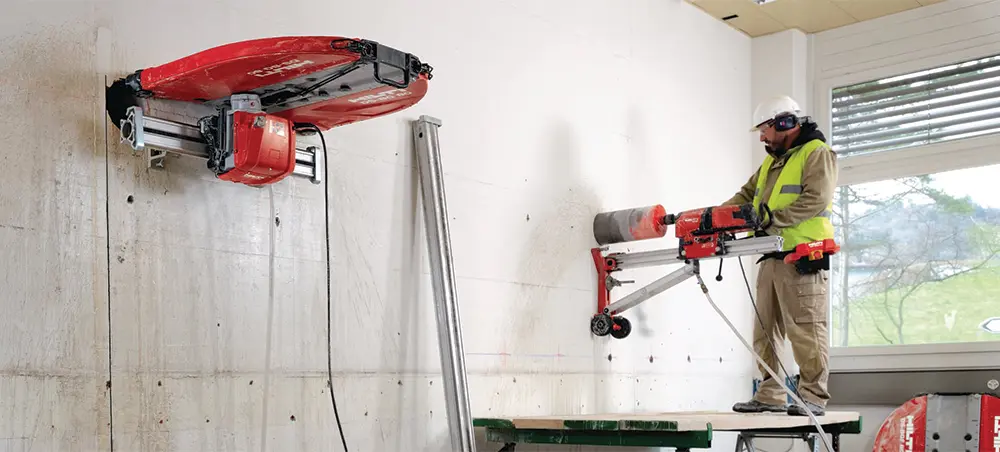
Hand saw cutting and small core holes are the cheapest option because one technician can usually finish the job in a single visit with hand-held equipment. Wall saw and floor saw cutting cost more because they need a track-mounted saw, a water supply for dust suppression, and more setup time. Wire saw cutting sits at the top of the range — it's the method used for thick, heavily reinforced elements like pile caps and mass foundations, and it usually means a two-person crew, specialised diamond wire, and a longer job on site. If a contractor quotes you the same flat rate regardless of which method your job actually needs, that's worth asking about.
Access and location matter more than people expect
A ground-floor warehouse slab in Al Quoz with a truck able to park right next to it is a straightforward job. The same cut on the 30th floor of an occupied tower on Sheikh Zayed Road, with the equipment going up in a service lift and work restricted to specific hours to avoid disturbing tenants, takes longer and costs more — not because the cut itself is different, but because everything around it is harder. If your site has restricted loading bay hours, security clearance requirements, or limited power access, mention it when you ask for a quote. It changes the number.
What's inside the concrete affects both price and time
This is the part most people don't think about until it happens on their site. A slab with ordinary rebar cuts differently — and faster — than a post-tensioned slab, which has steel cables under tension running through it that need to be identified and safely de-stressed before cutting near them. That's exactly why we always run GPR concrete scanning ahead of any cutting quote where we're not already familiar with the structure. It tells us what's actually in the slab, which means the quote we give you reflects the real job instead of a guess that might change once we're on site.
A few things that quietly add to the bill
- Debris removal. Cutting produces slurry and offcuts. Some quotes include haul-away, some don't — ask directly.
- After-hours or weekend work. Common in Dubai for occupied buildings and retail units that can't tolerate daytime noise.
- Dust and noise control. Wet cutting with proper containment costs a little more than dry cutting but is usually required on occupied or indoor sites.
- Mobilization distance. A one-off job in a far industrial zone may carry a call-out charge that a cluster of jobs in the same area wouldn't.
How to compare quotes properly
The best way to compare two concrete cutting quotes isn't to look at the bottom number — it's to check that both contractors are quoting for the same scope. Ask whether the price includes scanning, debris removal, and any out-of-hours surcharge, and whether it assumes standard rebar or accounts for the possibility of post-tension cables. A lower quote that leaves those out usually isn't actually cheaper once the job is finished; it just moves the cost to a change order later.
If you'd like an accurate number rather than a rough estimate, send us your drawings (or even just photos of the area and a rough idea of thickness) and we'll walk you through what the job will actually involve before we quote it. You can see the full range of methods we use on our concrete cutting services page, including dedicated coverage for projects in Ajman and Abu Dhabi as well as Dubai.