
Concrete Scanning · July 30, 2026 · Prime Edge Technical Services LLC
A few months back we got a call from a contractor whose team had cut into a slab to install a new drain line and hit a live electrical conduit halfway through. Nobody was hurt, but the building lost power to two floors for the better part of a day, and the client had to explain to their tenants why the lifts weren't working. It's the kind of call we get more often than you'd think, and almost every time, the same question comes up afterward: "could this have been avoided?" Yes. Almost always, yes.
Concrete isn't just concrete once it's poured
Once a slab or wall is cast, you're not just looking at concrete — you're looking at concrete with rebar grids, post-tension cables, conduits, pipes, and sometimes voids or old embedded fixtures nobody has records of anymore, especially in older buildings where the as-built drawings have gone missing over the years. None of that is visible from the surface. A drill bit or a saw blade doesn't know the difference between plain concrete and a live cable until it's already gone through it.
What GPR scanning actually does
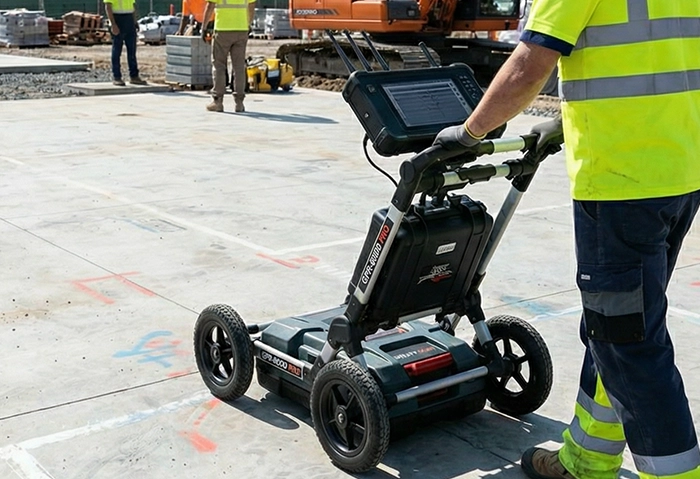
Ground Penetrating Radar scanning sends radar pulses into the concrete and reads what bounces back. Different materials reflect the signal differently, so a trained operator can tell the difference between a steel rebar, a plastic conduit, a void, and a post-tension cable — and mark their exact position and depth directly on the surface before anyone picks up a saw or a drill. It typically takes somewhere between fifteen minutes and an hour depending on the area, which is a small amount of time compared to the alternative.
Post-tension cables are the real danger, not just rebar
Ordinary rebar is a problem if you cut it — it weakens the structure and means you've damaged reinforcement you'll need to account for. But post-tension cables are under enormous tension, sometimes tens of tonnes per strand, and cutting one unexpectedly can cause a violent, dangerous release of that stored energy. A lot of towers and parking structures built in Dubai over the last two decades use post-tensioned slabs, and from the surface, a post-tensioned slab looks exactly like any other one. Scanning is the only way to know for certain before you cut.
It's not only about safety — it protects your schedule too
Hitting a live utility mid-project doesn't just create a safety incident. It usually means work stops on that floor, sometimes on the whole site, while facilities teams isolate the damage and figure out what else might be affected nearby. We've seen half-day jobs turn into week-long disputes over who pays for the repair. A scan that costs a fraction of that delay, done properly before the first cut, is one of the easier risk decisions on a construction site.
When we tell clients scanning isn't optional
- Before any core drilling, wall saw, or floor saw cutting on a slab you didn't build yourself.
- Before concrete chipping, breaking, or boring near existing MEP routes.
- On any building older than the drawings you have for it — as-built records get lost, and renovations rarely get documented properly.
- Before excavation near a slab or foundation, where we'd also recommend pairing it with underground utility detection for what's buried in the ground itself, not just inside the concrete.
If you're planning any cutting or drilling work and you're not completely sure what's inside the concrete you're about to go through, that uncertainty is the whole reason scanning exists. It's a short visit that turns a guess into a fact, and on a construction site, facts are worth a lot more than assumptions. You can read more about how our scanning process works on the concrete scanning services page, or get in touch and we'll talk through your specific site.